

by Jolanta Kruczynski

This is a profound and necessary question - because without a clear why, resilience can feel like just one more thing on an already overflowing plate.
In the context of parenting, resilience refers to the capacity of parents to adapt, recover, and grow in the face of stress, adversity, or challenges - both in their own lives and in the lives of their children.
Studies show that parental resilience is one of the strongest indicators of healthy child development. When parents can regulate their own stress, children feel safer, learn coping skills, and are less likely to develop anxiety or behavioural problems.
For parents raising ADHD children, resilience isn’t about being “stronger.” It is the single most practical tool for preventing collapse, sustaining effective parenting, and breaking the cycle of mutual dysregulation.
1. Your resilience helps you “bounce back” from parenting challenges
“Bouncing back” is not the same as "toughing it out" or "just surviving." In the context of parenting a child with ADHD, bouncing back means returning to a regulated, strategic, and compassionate state quickly enough to guide your child before the situation spirals.
Because children with ADHD have slower recovery times from emotional dysregulation, they rely on their parent's nervous system to be the "emotional anchor."
“Bouncing back” or resilience is a dual process. It requires the physiology (the body) to calm the nervous system’s stress response, and the cognitive (the mind) flexibility to reframe the adversity and integrate the experience into your life.
The physiological process (the body)
When you face challenging situations, your body goes into “fight or flight” mode. Resilience is about how effectively your body recovers from this state.
- Nervous system regulation: shifting from the sympathetic (stress) to the parasympathetic (rest) state.
- Hormonal down-regulation: clearing stress hormones like cortisol and adrenaline from the bloodstream.
- Somatic awareness: recognise physical tension (like a tightened chest or shallow breathing) and using tools like deep breathing or progressive muscle relaxation to signa safety to the brain.
The cognitive process (the mind)
Once the body calms, the brain requires mental flexibility to process and learn from the setback.
- Cognitive reappraisal: consciously changing how you interpret the situation. Reframe it as a manageable challenge or a learning opportunity.
- Meaning making: find a logical explanation for the challenging situation. This involves understanding the cause:” Why did this happen?” and “How can I grow from this?” The conscious recognition of positive secondary outcomes -discovering inner strength, clarifying your values and beliefs – build deeper empathy for your child.
- Attention regulation: focus away from dwelling on the negative and toward problem-solving and actionable next steps.
The physiological and cognitive processes influence each other continuously. You can use cognitive reframing to tell your brain “I am safe” in order to calm your physiological anxiety. Likewise, you can use controlled breathing to lower your heart rate and think clearly.
Parenting a child with ADHD often follows a predictable, destructive loop:
- Trigger: The child has a meltdown, refuses to comply, or acts impulsively.
- Parental Reaction: The parent feels frustrated, helpless, or embarrassed. Without resilience, this leads to yelling, threatening, or punishing.
- Child's Response: The child's behaviour escalates (fighting back, shutting down, or having a bigger meltdown) because their ADHD brain is overwhelmed.
- Parental Aftermath: The parent feels intense guilt, shame, and exhaustion, thinking, "I'm a failure."
Without resilience, you get stuck in this loop. Each cycle wears down your emotional reserves, leading to chronic stress, sleep loss, and eventually, parental burnout. With resilience, you can interrupt the cycle at step 2, “parental reaction”.
You pause, regulate yourself, and choose a different response. This single act of interruption is what "bouncing back" looks like in real time. It stops a 30-minute meltdown from ruining your entire evening.
A Quick "Bounce Back" Script for Your Inner Voice
When the challenge hits and you feel yourself sinking, resilience gives you this internal script to force the bounce:
- Stop. (Physically freeze your body.)
- Breath. (One long exhale to trigger the vagus nerve.)
- Label it.("I am dysregulated. This is adrenaline, not truth.")
- Reframe it.("My child’s ADHD brain is offline. I am the adult. I have the mature brain here.")
- Act. (One small, compassionate action toward the child or toward yourself.)
Resilience doesn’t mean avoiding these parenting challenges. Instead, it means:
- Regulating your own emotions so you don’t react impulsively.
- Problem-solving effectively rather than feeling helpless.
- Maintaining a sense of hope and perspective after a difficult parenting moment.
Without resilience, you become a second dysregulated person in the room, not the calm anchor your child needs.
2. Your resilience protects your child’s sense of self.
A child’s sense of self is not built in isolation. For young children, their identity is stored in their parent's brain. When your child is dysregulated, they cannot access logic, memory, or self-worth. They need you to be their "external hard drive" - to hold their positive identity for them until they can internalize it.
A child with ADHD receives an average of 20,000 more negative messages by age 12 than their neurotypical peers (from teachers, peers, relatives, and even strangers). They are constantly told: "Try harder," "Stop being lazy," "Why can't you just behave?"
Over time, this external criticism becomes internalized as shame, anxiety, oppositional behaviours and low self-esteem. The child stops thinking, "I have a problem with focus" and starts thinking, "I am a problem." That is the collapse of their sense of self.
Here are few steps how your resilience actively builds your ADHD child’s sense of self - not through praise, but through lived experience.
Step 1. Your Resilience Decouples "Behaviour" from "Identity"
Children with ADHD receive constant, negative feedback about their behaviour (they are loud, impulsive, forgetful, or messy). Without a resilient parent, the child conflates this feedback into: "My behaviour is bad; therefore, I am bad."
How your resilience changes this:
- You pause and ask: "Is this wilful defiance, or is it an ADHD brain struggling?"
- You separate the action from the person.
- Exhausted, but consistent - because resilience gives you the clarity to separate behaviour from being.
Step 2: Your Resilience Allows You to Narrate Their "Positive Story"
One of ADHD's hidden impacts is time blindness and poor memory recall. A child with ADHD may forget the 10 good things they did today and only remember the one big mistake. They often cannot access positive memories of themselves.
How your resilience changes this:
- You are calm enough to narrate their strengths back to them during quiet moments.
- You actively store their positive moments (because your working memory is still functioning) and remind them of who they are when they cannot see it.
Example Script:
"I know you felt like a failure at school today. But I want you to remember who you are. You are the kid who checked on your friend when she was sad. You are the kid who built that amazing LEGO tower. You are the kid who made me laugh so hard this morning. That is the real you. The hard moments are just a part of your day - they are not who you are."
Your resilience gives you the energy to deliver this powerful narrative when your child needs it most—after a failure.
Step 3: Your Resilience Lets You Create "Competence Islands"
Children build self-esteem not by being told they are great, but by doing hard things successfully. However, an ADHD child often avoids challenges because they have a history of failure and feel shame.
How your resilience changes this:
- You are patient enough to identify their "Competence Islands” - the specific activities where their ADHD traits are assets (e.g., creativity, humour, problem-solving, sports, music, or video games).
- You relentlessly protect time for these activities, even when school demands are piling up, because your resilience allows you to prioritize their identity over just their grades.
Action:
- You set up small, achievable challenges within that competence island:
"I know you can figure out this level. I'll sit with you, but you lead."
- When they succeed, you don't just say "Good job." You say:
"Look at that. You used your focus and creativity to solve that. That is a real strength of yours. That is who you are."
Over time, these islands connect into a continent of self-worth.
Step 4: Your Resilience Allows for "Repair" After Rupture
This is arguably the most powerful builder of self. You will lose your cool. You will say things you regret. That is inevitable.
How your resilience changes this:
- Because you can bounce back from your own shame, you can approach your child and repair the rupture without making excuses.
- You model that mistakes are part of being human, and relationships can survive conflict.
The Repair Script:
"I yelled at you earlier. That was not okay. I was overwhelmed, but that is not your fault. I am so sorry. You did not deserve that. I love you, and I will keep working on staying calm. We are okay."
What these builds in your child:
- They learn they are worthy of apology.
- They learn they are strong enough to receive an adult's vulnerability.
- They internalize: "Even when I make mistakes, people will still stay. I am worth staying for."
Step 5: Your Resilience Gives Them Permission to Be Imperfect
ADHD kids often develop perfectionism as a shield against criticism - ironically, this makes them more anxious and less able to try new things.
How your resilience changes this:
- You are comfortable with chaos and mess because you've accepted that ADHD is a marathon, not a sprint.
- You openly make mistakes in front of your child and laugh at them.
- You say things like:
"Well, I messed that up! Let me try again. Watch - this is how we handle failure in this house. We shake it off and go again."
Your child watches you fall, get back up, and keep going. They internalize: "It is safe to fail. I am not my mistakes."
Parents act as “emotional coaches.” When children see a parent handle frustration calmly, apologize after a mistake, or persist through a hard day, they internalize those skills. Resilience is thus caught, not just taught.
3.Resilience preserves your executive functioning
Raising a child with ADHD places relentless, daily demands on the parent's executive functions - the very same cognitive skills that are often impaired in the child. Without resilience, the parent's executive functioning will degrade, leading to poor decisions, emotional outbursts, and support system collapse. With resilience, those executive functioning capacities are preserved and even strengthened.
Chronic parenting stress elevates stress hormone (cortisol) and prolonged high cortisol directly impair these very same brain functions:
- damages the prefrontal cortex (your executive functioning headquarters)
- weakens top-down control over the amygdala (emotional reactivity)
- impairs neuroplasticity (ability to learn new parenting strategies).
Think of your executive functioning as a battery. Chronic frustration drains the battery rapidly. You become forgetful, rigid, and quick to anger - making every challenge harder.
Resilience practices (mindfulness, social connection, cognitive reframing, sleep hygiene) lower cortisol and protect prefrontal structure and function. They literally keep your brain's executive functions hardware intact.
Resilience acts as a power-saving mode. When you bounce back quickly from a challenge (using strategies like a time-out or reframing), you prevent parental burnout. You preserve that precious mental energy needed to plan a visual schedule, remember doctor's appointments, or patiently guide your child through their homework.
How parenting a child with ADHD attacks executive functions:
1. Inhibition (self-control)
Child talks back, has a meltdown, or refuses to listen – you must stop yourself from yelling, hitting, or walking out.
2. Working memory
You must remember medications, appointments, school deadlines, behaviour plans, and what you just said 30 seconds ago.
3. Emotional regulation
The chaos triggers your own frustration, anxiety, helplessness, or rage – you must calm yourself before responding.
4. Cognitive flexibility
Plans fail constantly (morning routine derailed, homework refusal). You must pivot instantly without breaking down.
5. Task initiation
You are exhausted but must start another difficult conversation, another bedtime battle, another school email.
6. Sustained attention
You must focus on the child’s needs despite interruptions, phone calls, sibling demands, and your own fatigue.
7. Planning and prioritization
Everything feels urgent. You must decide: discipline now or later? Therapy or tutoring? Sleep or paperwork?
What Happens Without Resilience
Without resilience, chronic stress erodes your executive functions in a predictable sequence:
Stage 1 - Overload
You try to use all your executive functions every day, with no recovery. Working memory starts failing: "Did I give the morning meds?" Inhibition weakens; you snap at the child or spouse.
Stage 2 - Impairment
Emotional regulation degrades. Small triggers (a lost shoe) cause disproportionate rage or tears. Cognitive flexibility disappears; you get stuck on “, but the plan was X" and can't pivot.
Stage 3 - Burnout
Task initiation collapses. You sit on the couch knowing what needs to be done but cannot move. Planning is impossible. You feel "brain dead."
Stage 4 – Executive Dysfunction
You now resemble someone with acquired executive functions deficits: impulsive decisions, emotional lability, poor judgment, inability to sequence tasks. You may make dangerous parenting choices (leaving child unattended, harsh punishment) not from malice but from cognitive collapse.
At this point, you cannot access parenting strategies you know work - because your executive functions are offline.
How Resilience Preserves Your Executive Functions
Resilience is not a feeling; it is a set of behavioural and cognitive strategies that reduce the executive functions load on you, allowing your brain to recover and function.
Resilient Practice How it protects your executive functions
1. Automation and routines 1. Offloads working memory
Visual schedules, phone reminders, pill organizers. You don’t have to remember; the system remembers for you.
2. Planned pauses 2. Restore emotional regulation
5 minutes of deep breathing after school pickup. Cooldown prevents reactive parenting.
3. Lowered expectations 3. Protects planning and prioritization
Choose one non-negotiable; let the rest go. You stop trying to do everything, conserving executive functions for what matters.
4. Scripted responses 4. Preserves inhibition and task initiation.
“I see you are upset. We will talk when both calm.” You don’t need to invent response under stress.
5. Externalized problem-solving 5. Spares cognitive flexibility and working memory.
Write it down, talk to another parent, use a checklist. The paper or friend holds the options.
6. Radical acceptance 6. Reduces emotional dysregulation
“This is hard. I am doing my best. He is doing his best.” By removing the fight against reality.
7. Sleep and nutrition boundaries 7. Restores sustained attention and task initiation.
You stop sacrificing your own basic needs. A tired, hungry brain has no executive functions to spare.
Resilience preserves the parent's executive functioning under the chronic, high-demand conditions of raising a child with ADHD. Without resilience, executive functions degrade, and the parent becomes less capable of exactly what the child needs: calm, consistent, flexible, organized care. With resilience, the parent maintains the cognitive capacity to parent effectively, day after day.
4. Resilience prevents the collapse of your support systems
Resilience acts as a buffer for parents, preventing their emotional, psychological, and practical support systems from breaking down under chronic stress.
Parenting challenges don't just affect you and your child; they put immense strain on your marriage, your relationship with extended family members, and your friendships.
Why parents of children with ADHD are at high risk for system collapse?
Raising a child with ADHD is not just "busy parenting." It often involves:
- Chronic, unpredictable stress (meltdowns, impulsivity, school calls, homework battles).
- Social judgment (people assuming it’s bad parenting).
- Marital strain (disagreements on discipline or medication).
- Exhaustion (hyper-vigilance and repeated instructions).
- Isolation (avoiding playdates or public outings).
Without resilience, these pressures cause a domino effect:
- Individual coping fails (parent becomes anxious or depressed).
- Social support erodes (friends and family pull away due to the chaos).
- Practical support breaks (parent misses work, can’t afford therapy, stops attending school meetings).
- Family unit destabilizes (increased conflict, possible separation).
How resilience prevents that collapse
Resilience isn't about "toughing it out." It’s a set of skills and mindsets that maintain the integrity of support systems under pressure.
Support system Without resilience With resilience
Parent’s own mental health Burnout, helplessness, chronic stress Self-regulation, ability to recover after a meltdown
Martial/partner Blame, withdrawal, resentment Teamwork, shared language about ADHD, repair after arguments.
Extended family and friends “You just need to discipline him”. Educated supporters, scheduled breaks for Isolation. parents.
Professional help Giving up after one bad therapist Persistence in finding ADHD -informed providers.
or school refusal.
Daily routines Chaotic mornings, no structure. Flexible routines, use of visual schedules and timers.
The Key Resilient Mindsets & Actions That Prevent Collapse
- Reframing (from "badness" to "brain difference")
Instead of "He’s defiant to hurt me," → "His ADHD brain struggles with transitions." This reduces shame and blame, keeping the relationship - Proactive rest, not reactive exhaustion
Resilient parents schedule breaks before they need them (e.g., 15 minutes of quiet after school drop-off). This prevents the nervous system from reaching collapse. - Building a "resilience network"
Not just venting friends, but other parents of ADHD kids who understand the 3 AM ER visit for impulse control issues. This network provides validation and practical advice. - Lowering standards strategically
Resilience means knowing what must work (medication, sleep, school communication) vs. what can slide (perfect table manners, tidy bedroom). This prevents overextension. - Learning repair & reconnection
After a parent yells (which will happen), resilience allows them to apologize, repair, and reconnect with the child. This keeps the parent-child support system functional, not shattered.
Resilience is the active, learnable skill that prevents the cascading failure of a parent’s support systems. For parents of children with ADHD, building resilience is not a luxury - it is the difference between managing the condition long-term versus experiencing complete family systems breakdown.
Resilience allows you to compartmentalize a single parenting failure, so it doesn't infect every other area of your life. Bouncing back from a challenge with your child means you can still be a present parent, a calm partner in your marriage, and a connected friend.
5. Without resilience, self-compassion feels like weakness
On the surface, resilience (bouncing back, pushing through) and self-compassion (being kind to oneself in struggle) can seem like opposites. But when raising a child with ADHD, they become two halves of a necessary whole.
The Core Challenge of Raising an ADHD Child
- Repeated, daily challenges (homework battles, emotional outbursts, forgetting instructions).
- Inconsistent progress (what worked yesterday fails today).
- Public judgment (accusations of "bad parenting" or a "spoiled child").
- Internal guilt (wondering if you're doing enough or blaming your child's struggles on yourself).
In this environment, resilience alone becomes brittle, and self-compassion alone becomes passive. Together, they create sustainable strength.
How Resilience and Self-Compassion Complement Each Other
If you have… The problem is… How the other trait fixes it…
Only Resilience You suppress exhaustion, shame and guilt. Self-compassion gives you permission to rest, acknowledge hard movements, and forgive mistakes.
You “push through” until burnout, resentment,
or yelling.
Self-compassion gives you permission to rest, acknowledge hard movements, and forgive mistakes.
Only Self-Compassion
You may avoid necessary limits, structure, or follow through, because conflict feels unkind. You risk enabling chaos under the guise of “acceptance”.
Resilience gives you the courage to set firm boundaries, try failed strategies again, and tolerate your child’s distress without rescuing them.
Resilience and Self-Compassion together form a cycle
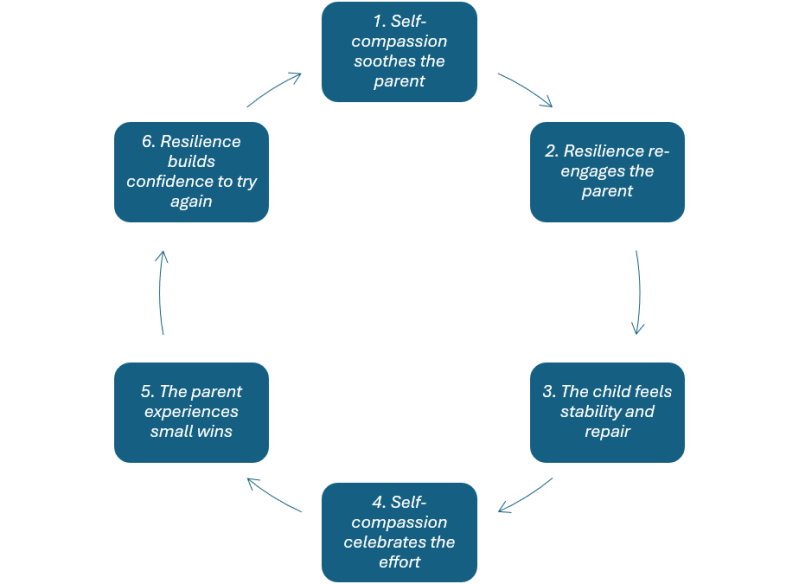
The Science & Why It Works for ADHD Parenting
- ADHD is a neurobiological disorder, not a character flaw. Your child’s brain lacks sufficient dopamine and executive function. Consequences are not always "teaching moments" - sometimes they’re just exhausting. Self-compassion prevents you from taking non-compliance personally. Resilience prevents you from giving up on necessary structure.
- Regulation is caught, not taught. Children with ADHD regulate through co-regulation. When you model self-compassion after a mistake (e.g., "I yelled, I’m sorry, let me breathe"), your child learns to recover from their own outbursts. When you model resilience (e.g., "That homework session was awful, but we’ll try a timer tomorrow"), they learn persistence without shame.
For an ADHD child - who will face more daily friction, more external criticism, and more emotional volatility than most neurotypical children - a parent who models this balanced strength is giving the greatest gift: the lived example that struggling and kindness can coexist, and that perseverance is not about being tough, but about being tender with yourself while still showing up.
Resilience is not for your child. It is for you. And because it is for you, it becomes the greatest gift you can give them.
If you remember nothing else: A burned-out parent cannot regulate a dysregulated child. A resilient parent doesn’t need to be perfect - only present.
Add comment
Comments